odp
217 to 240 of 302 locations
-
Fort Everdingen
Fort Everdingen
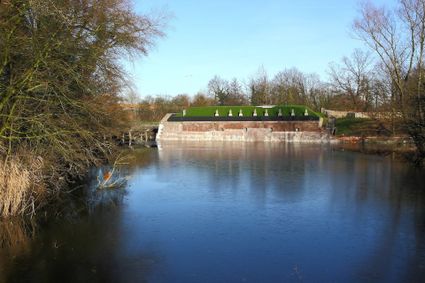
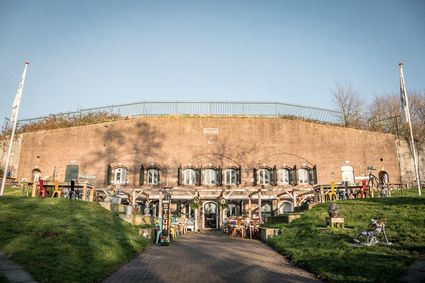
Anyone who delves into the history of the Vijfheerenlanden will soon discover that the now very quiet and peaceful area has a history filled with clashing weapons. Destroyed towns and castles, plundering and domestic (and foreign) wars: every town and village has its own story to tell. Everdingen was put on the Dutch military map in the 19th Century as part of the New Dutch Water Line.
The New Dutch Water Line ran from the former Zuiderzee near Muiden to the Biesbosch near Werkendam and consisted of a variety of defences and inundation fields (areas that could be placed underwater). Fort Everdingen was built between 1842 and 1847 and, together with Fort Honswijk, formed the Lek access on the other side of the Lek. The surrounding land could be flooded using inundation locks. The fort itself was walled and well defended by a variety of casemates. The new Dutch Water Line was prepared 3 times. At the end of World War II, German forces used the line as a defence against the advancing Allies. Fort Everdingen lost its defensive function after the war. The military Explosive Ordinance Disposal service used the fort until 2014. It’s now home to the German & Lauret brewery, which uses the special water filtering system in their brewery. It’s also an over-wintering place for many bats.
Further reading: Batestein Castle, Hagestein Castle, Vianen Castle, Brederode statue, Everdingen village centre, Vianen water tower. Noodweg 2
4121 KK Everdingen -
Eemlandhoeve
Eemlandhoeve Bisschopsweg 7
3752 LK Bunschoten-Spakenburg -
Winkel van Sinkel
Winkel van Sinkel Winkel van Sinkel
Oudegracht 158
3511 AZ Utrecht -
TOP Huis Doorn
TOP Huis Doorn Langbroekerweg 10
3941 MT Doorn -
Bijzondere Taarten Fabriek
Bijzondere Taarten Fabriek 1e Hogeweg 160
Zeist -
Café-Restaurant De Lage Vuursche
Café-Restaurant De Lage Vuursche Dorpsstraat 2
3749 AD Lage Vuursche -
The Waterloo Needle
The Waterloo Needle Torenlaan
3742 CR Baarn -
TOP City harbour Wijk bij Duurstede
TOP City harbour Wijk bij Duurstede Bij stadspoort naar de haven
Havenweg
3961 AW Wijk bij Duurstede -
Visitor Centre De Boswerf
Visitor Centre De Boswerf Prins Bernhardlaan 3
3708 BR Zeist -
Delicacies from Zeist
Delicacies from Zeist Centrum Zeist
3701 Zeist -
TOP Zeist Castle
TOP Zeist Castle Zinzendorflaan 1
3703 CE Zeist -
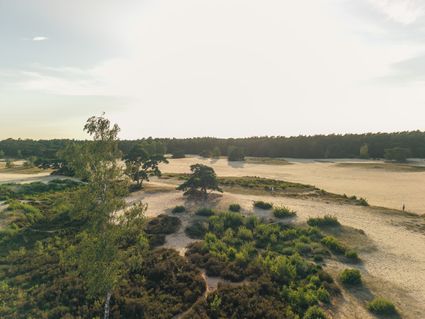
Dunes of Soest
Dunes of Soest 3768 Soest
-
Bicycle Boat, stop Breukelen
Bicycle Boat, stop Breukelen Fietsboot over de Vecht, opstapplaats Breukelen
Herenstraat 41
3621AP Breukelen -
Museum IJsselstein
Museum IJsselstein Walkade 2
3401 DS IJsselstein -
Pannenkoekenhuis de Grebbeberg
Pannenkoekenhuis de Grebbeberg Grebbeweg 101
3911 AV Rhenen -
Fort Honswijk
Fort Honswijk
Fort Honswijk, situated on the Lek River, is one of the most prominent forts of the New Dutch Waterline. Fort Honswijk's tower (built between 1841 and 1848) is the oldest and largest in the Waterlinie and possesses singular architectural beauty. Fort Honswijk was designed to stop the enemy from crossing the Lekdijk dike and to close off the Lek River in cooperation with Fort Everdingen on the opposite banks of the Lek.
Lekdijk 58
3998 NJ Schalkwijk -
Fort Vreeswijk
Fort Vreeswijk Fort Vreeswijk 1a
3433 ZZ Nieuwegein -
Molen de Ster
Molen de Ster Utrecht
-
Fort Nigtevecht
Fort Nigtevecht Fort bij Nigtevecht
Velterslaan 1
1391 HV Abcoude -
Diefdijk
Diefdijk
This centuries-old long dyke marks the border between the Betuwe to the east and the lowlands to the west. The purpose of the Diefdijk was to protect the lower-lying meadows whenever the higher Betuwe flooded. The dyke was reinforced in 2015 and still serves its purpose today. It was also part of the New Dutch Waterline: the area to the east of the dyke served as an inundation area. To this day, this area remains scarcely built up. Nature reserves of various sizes border the dyke on either side.
Diefdijk
Diefdijk
4143 MG Leerdam -
Canals and shipyards
The Utrecht canals with their wharves and wharf cellars are unique in the world.
The 12th Century Oudegracht was built to change the course of the Oude Rijn river. Connecting the river Vecht in the north to the Vaartsche Rijn in the south, the Oudegracht was destined to become an elongated harbour. Large city castles were built along the canal and in the 13th Century, shipyards were built as second streets at water level. The deep cellars, serving as storage spaces, ran through to below the houses. Today, the canals and shipyards are home to shops, restaurants and private residences.
Oudegracht 0
3511 AZ Utrecht -
Hotel 't Wapen van Harmelen
Hotel 't Wapen van Harmelen Dorpsstraat 14
3481 EK Harmelen -
Gagelbos
Gagelbos Gageldijk 104
3566 MJ Utrecht -
TOP Kersenpracht Cothen
TOP Kersenpracht Cothen Restaurant De Jonge Graaf
Graaf van Lynden van Sandenburgweg 2
3945 PB Cothen