odp
73 to 96 of 302 locations
-
TOP Huis Doorn
TOP Huis Doorn Langbroekerweg 10
3941 MT Doorn -
Fort aan de Klop
Fort aan de Klop 1e polderweg 2
3563 MC Utrecht -
Pannenkoekenhuis Bergzicht
Pannenkoekenhuis Bergzicht Doornseweg 23
3931 MH Woudenberg -
Vechtstreekmuseum Maarssen
Vechtstreekmuseum Maarssen Diependaalsedijk 19b
3601 GH Maarssen -
Teahouse Mon-Chouette
Teahouse Mon-Chouette Leusbroekerweg 25
3831 JZ Leusden -
Fort Waver-Amstel
Fort Waver-Amstel Waverdijk 19
3646 AS Nessersluis -
Pyramid of Austerlitz
Pyramid of Austerlitz Zeisterweg 98
3931 MG Woudenberg -
TOP Park Vliegbasis Soesterberg
TOP Park Vliegbasis Soesterberg Verlengde Paltzerweg 1
3768 MX Soest -
Grote Kerk Vianen (Great Church)
Hubrecht van Vianen founded a chapel in the 13th Century. It fell under the mother church in Hagestein and began growing fast. In the year 1345, it became a parish church and was granted marriage and burial rights. For this, a sum of money had to be paid to the church in Hagestein annually. In the 14th Century, the chapel was replaced by a single-nave church. In the year 1433, following a feud between Vianen and Hagestein, the Bishop of Utrecht decided to split the two churches.
In the mid-15th Century, the church was replaced by a 3-aisle Gothic hall church which is the same size as the current church. (Including the tower, it’s 77.5 metres long, 43 metres wide and 41 metres high.) Since the church also contains the family graves of the Lords of Vianen, it was required to match the grand status of the Brederodes in terms of its size and appearance.
After a fire in the year 1540, the church (de Grote Kerk) was rebuilt in its current form almost immediately (as a combination of a hall church and cruciform church) with the support of Reinoud III van Brederode. The church became Reformed under his son, Hendrik van Brederode. On 25 September 1566, the Roman Catholic institution disappeared and then, on 1 October, the first Protestant service was held.
Discover all monuments in Vianen. Grote kerk Vianen
Voorstraat 110
4132 AT Vianen -
Museum IJsselstein
Museum IJsselstein Walkade 2
3401 DS IJsselstein -
Cheese Warehouse | Cheese Experience
Cheese Warehouse | Cheese Experience VVV Woerden
Emmakade 6A
3441 AJ Woerden -
UIT in IJsselstein I Tourist Info
UIT in IJsselstein I Tourist Info Overtoom 7
3401 BK IJsselstein -
Asschatterkeerkade
Asschatterkeerkade
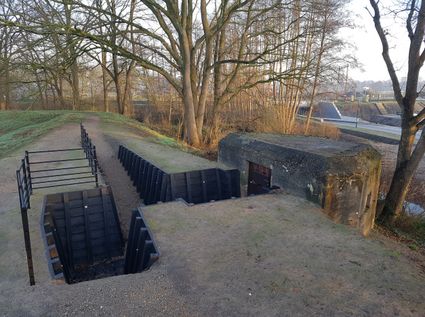
The Asschatterkade dates from 1745, and is one of the longest trenches of the Grebbelinie, with its length of 2500 metres. The trench from 1799 lies east of Leusden, at the edge of the flood plain. But there are also elements from more recent history which can be found.
The nine visible military bunkers, for example, were built during the mobilisation between 1939-1940. There is also a unique concrete tank barrier from this time. During the May Days of 1940, the Germans attempted in vain to break through the defences.
Hagenouwselaan 0
3831 JP Leusden -
Mill "Den Olden Florus"
Mill "Den Olden Florus" Stoutenburgerweg 20
3784 VE Terschuur -
Groene Entree & recreatie Doornse Gat
Groene Entree & recreatie Doornse Gat Leersumsestraatweg 0
3941 MN DOORN -
Noorderpark Ruigenhoek
Noorderpark Ruigenhoek Noorderpark Ruigenhoek
Utrecht -
TOP Ameide
TOP Ameide Lekdijk Loswal
4233CL Ameide -
TOP Leerdam
TOP Leerdam TOP Leerdam
Lingedijk 8
4142 LD Leerdam -
Grebbeberg Military Cemetery
The largest battle of the Dutch army in WWII took place on Grebbeberg Hill. Here poorly armed and untrained men held their ground against a very powerful and ruthless opponent for three days. Grebbeberg Military Cemetery is the final resting place for more than 800 soldiers and 1 citizen who perished here in the Second World War. It is located on Grebbeberg Hill at Rhenen, and was a battlefield of just a few square kilometres, but is full of stories of the courage of desperation in the Netherlands.
The information centre, with an exhibition about the events on Grebbeberg Hill during “The Battle for Grebbeberg Hill” in May 1940, is open daily from 9:00 am to 5:00 pm.
Grebbeweg 123
3911 AV Rhenen -
TOP trainstation Driebergen-Zeist
TOP trainstation Driebergen-Zeist TOP Station Driebergen-Zeist
Stationsplein, Driebergen
3972 NG Driebergen Rijsenburg -
Goejanverwelle lock
Goejanverwelle lock
The Goejanverwelle lock and the Enkele Wiericke lock on the Hollandse Ijssel played a key role in the Disaster Year. Together with the lock at Nieuwerbrug on the Oude Rijn, they formed the inlet to the Langeweide polder, which was the narrowest section of the Waterline. The locks were opened on 17 June 1672 – just in time to halt the advance of the French, who had already captured Oudewater and marched right up to the edge of the hastily flooded Waterline. With great promptitude, the commander of the garrison at Goejanverwelle, the Count of Horn, gave the order to raise sconces and fortifications to defend the locks. For the moment, the Waterline was safe!
Goejanverwellesluis
3467 PR Hekendorp -
TOP Het Gagelgat
TOP Het Gagelgat Birkstraat 107
3768 HD Soest -
Castle Groeneveld
Castle Groeneveld Kasteel Groeneveld
Groeneveld 2
3744 ML Baarn -
Werk aan het Spoel
Werk aan het Spoel
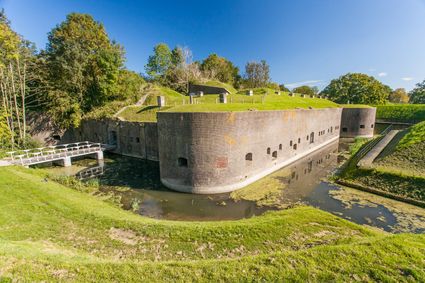
In 1815, a fan lock was built into the Lekdijk near Goilberdingen for inundation purposes. It was protected by an earthen battery. In 1848, the battery was upgraded to a fort. Later on, the inundation system was optimised, and four bomb-proof buildings were added to the fort. In peacetime, the road on top of the dyke ran right through the fort, but traffic was led around the fort in times of mobilisation. In 1939, seven concrete shelters and two machine gun casemates were added. An unusual feature is the high free-standing wall in a field to the south of the fort. This was the stop butt of a German firing range.
Goilberdingerdijk 40
4106 LC Culemborg